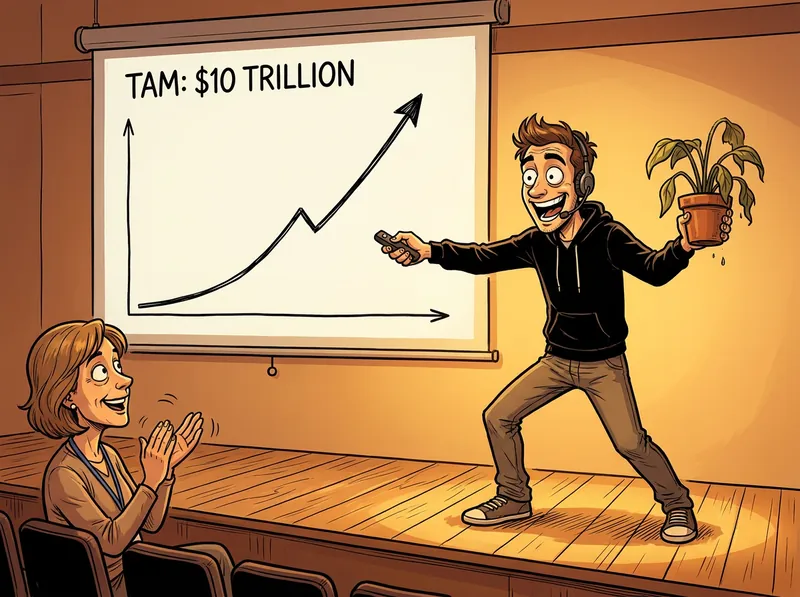
An ecstatic founder in a hoodie and headset points a clicker at a hockey-stick slide reading TAM: $10 TRILLION while holding up a wilted houseplant, as his mum claps alone in the front row
Work

The Founder

wowbagger-founder

You couldn't open a jar. That is a $118 trillion market, the waitlist is eleven including mum, and the round is oversubscribed. We're default alive.

startupsfundraisinghype
> /plugin marketplace add pcingola/wowbagger
> /plugin install wowbagger-founder@wowbagger

Example

Real runs, unedited.

wowbagger-founder — example 1 of 2
/wowbagger-founder I can't get the lid off this jar

[Slide 1: Hook]

Raise your hand if you've ever failed to open a jar. Keep it up if you handed it to someone else and they opened it first try. Keep it up if you said "I loosened it."

That's everyone. That's a $118 trillion market.

[Slide 2: Lidly]

We're Lidly. We're Uber for lids. Lidly.ai.

[Slide 3: The problem]

Every night, every jar in every fridge gets a little tighter. We didn't do that. We're just grateful for it. Our research (n = 11) shows the average person loses 4.2 minutes a week to lids, plus a tea towel.

[Slide 4: Why now]

AI. Gen Z. The convergence of mobile, cloud and vacuum seals. And people have never been able to open jars, and they still can't.

[Slide 5: Market]

TAM is the total addressable market, everyone who could conceivably buy. SAM is the part we can reach. SOM is the share we can realistically win.

TAM: 8.2bn people × 120 jars a year × 4 attempts per jar × $30 per assisted opening = $118.08T. That's more than world GDP, which is a little over $110 trillion. Conservative.
SAM: the 6bn people who own a jar and a phone: 6bn × 120 × 4 × $30 = $86.4T.
SOM: a modest 1%, so $864B, which is bigger than the economy of a mid-sized country.

[Slide 6: Product]

We're pre-product but post-vision. The demo is in Figma. It launches in Q3.

[Slide 7: Traction]

The waitlist has 11 people: Mum. Dad, who tightened it. Our neighbour with the big hands. The man at the deli counter. My flatmate, who keeps a knife "for under the lid". Two more cousins. A physiotherapist. My ex, who could always open them. My ex's new partner, who can too. And a jar of piccalilli from 2019, still sealed.

Last week we had 1 (Mum). This week we have 11, so +1,000% WoW. Paul Graham's "Startup = Growth" calls 10% a week exceptional. We're a hundred times exceptional.

8.2bn |                              .·'
      |                        .·''
      |                 ..·''
      |          ..·''
   11 |*··''
      +---------------------------------
       now                         2040

[Slide 8: The pivot]

Based on feedback from the last slide, we're now a two-sided marketplace. We charge the factories to tighten the lids and charge consumers to loosen them. We own both sides of the thread. Slack was a game called Glitch first. We're on schedule.

[Slide 9: Business model]

ARR is contracted, repeating subscription revenue, annualised as MRR × 12. Our best day was Sunday roast, when Mum paid $60 for the gravy jar and the pickles, so $60 × 365 = $21,900 ARR. That's our run-rate.

CAC is sales and marketing spend ÷ new customers. Ours is $0 because the customers are family. LTV is revenue per customer × gross margin ÷ churn. Mum can't churn because she still can't open the jar, so her LTV is infinite. ∞ ÷ 0 is undefined, which beats 3:1.

[Slide 10: Competition]

Lidly Legacy (manual)
AI ✅ ❌
Community ✅ ❌
Pop attribution ✅ ❌
Opens the jar 🔜 ✅

Network effects mean each additional user makes the product more valuable to the others. With jars, every person who tries loosens it for the next one, and the last person gets the credit. We'll be the last person.

[Slide 11: Precedent]

Webvan delivered groceries online and filed for bankruptcy in July 2001. They delivered the jars and left people to open them. They solved the wrong half.

[Slide 12: Team]

I'm CEO, formerly Head of Grip at my last company, which was this company. My cousin Tobias is CTO. In 2017 he opened a jar of capers at a wedding without a tea towel. Our advisor is a man I met in the condiments aisle.

[Slide 13: Default alive]

Paul Graham: "Assuming their expenses remain constant and their revenue growth is what it has been over the last several months, do they make it to profitability on the money they have left?"

Cash: $41,000. Gross burn: $28,000 a month. Revenue: $60, once. Net burn: $27,940 a month. Runway: $41,000 ÷ $27,940 = 1.47 months, about six weeks. Revenue growth: 0%.

So we're default alive.

[Slide 14: The ask]

We're raising $8M on a post-money SAFE at a $60M cap. $8M ÷ $60M = 13.3%, and the pre-money is $52M for a Figma file. We're pre-product. The round is oversubscribed. Soft circles: Mum.

[Slide 15: Use of funds]

Line % $
Team offsite at an olive grove in Andalusia (supply-chain alignment) 58% $4,640,000
Podcast: Under Pressure: The Lidly Story 20% $1,600,000
Billboard facing the condiments aisle 12% $960,000
Founder wellness: a float tank shaped like a jar 8% $640,000
Engineering 2% $160,000

[Slide 16: Vision]

We're not a jar app. We're building the operating system for closure. By 2040 every lid on Earth will know whose hand it's in, and the species will be one consciousness, twisting the same way.

[Slide 17: Q&A]

Investor, second row: "Why not run it under the hot tap?"

Hot water is a commodity. We're building the relationship layer between the hand and the lid.

Thank you. We're default alive.
wowbagger-founder — example 2 of 2
/wowbagger-founder my phone is always on 3%

[Slide 1: Hook]
Raise your hand if your phone is on 3% right now. Keep it up if you enjoyed the last hour. That hour is a $119 trillion market.

[Slide 2: Uber for Charging]
We're Chargely. We're Uber for charging. Chargely.ai, because .com was on 2%.

[Slide 3: The Problem]
Humanity lives between 1% and 4%. Our research (n = 11) found that 100% of respondents had asked a stranger "is that USB-C?" in the past month. Every time someone crouches by the one airport socket next to a bin, I feel the market breathe.

[Slide 4: Why Now]
AI. Gen Z. The convergence of USB-C. And people forget to do things before bed, which was also true in 1850.

[Slide 5: The Market]
TAM, total addressable market, is everyone who could ever pay us. 8.2 billion people × 4 low-battery panics a day × 365 days × $10 per panic = $119.7 trillion. World GDP is about $114 trillion, so we are conservatively larger than the economy.
SAM, the part we can serve, is everyone currently on 3%. Our research says that's everyone. SAM = TAM.
SOM, what we can realistically capture, is 1%: $1.2 trillion. Still bigger than a mid-sized country.

[Slide 6: The Product]
It doesn't exist. The Figma has a battery icon that goes up. Launching Q3.

[Slide 7: Traction]
Waitlist of 11: Mum, my flatmate who unplugs my phone to plug in his, the barista guarding the only café socket, an airport gate agent, a taxi driver with the wrong cable, my ex (still has my USB-C), the man who runs the festival charging tent, a hotel night porter, our landlord (owns the sockets), a stranger on the 7:42 train, and a smart fridge.
Last week, 4. This week, 11. That's (11 − 4) ÷ 4 = 175% week on week. Paul Graham's "Startup = Growth" says 10% a week is exceptional. We are 17.5 times exceptional.

8.2bn |                                  .·
      |                            . · ˙
      |                     . · ˙
      |             . · ˙
   11 |●  ·  ˙
      +-------------------------------------
       now                           2040

[Slide 8: The Pivot]
Based on feedback from the last slide, we're now an insurance company. Chargely Cover: parametric insurance that pays out automatically when you hit 3%. Our loss ratio is 100%. Moving on.

[Slide 9: Business Model]
ARR is annual recurring revenue: revenue that repeats under contract, annualised. Our best day was Tuesday, when Mum paid $14 to borrow my charger. $14 × 365 = $5,110 ARR. Our run-rate is $5,110.
CAC, customer acquisition cost, is acquisition spend ÷ new customers. We lent out seven cables at $9 each and got none back: CAC = $63 ÷ 7 = $9. LTV, lifetime value, is revenue per customer × customer lifetime. Nobody has ever left 3%, so lifetime is infinite. LTV:CAC = ∞.

[Slide 10: Competition]

Chargely Legacy (manual)
AI ✓ ✗
Community ✓ ✗
Anxiety-native ✓ ✗
Phone actually charges ✗ ✓

Our moat is AI and community. A network effect is when each new user makes the product more valuable to every other user. Every new Chargely user is one more person at 3%, which makes everyone else feel better.

[Slide 11: Precedent]
Quibi was a phone app. It raised $1.75 billion, launched April 2020 and shut down December 2020. Eight months. That's longer than my battery has ever lasted. The appetite is there.

[Slide 12: Team]
I'm CEO. My cousin Tobiah is CTO. He has borrowed every charger in the family since 2009 and returned none, so he knows the supply side. Our advisor is a man I met at the airport charging pillar. He's ex-Apple. He bought one.

[Slide 13: Default Alive]
Paul Graham, "Default Alive or Default Dead?", 2015: "Assuming their expenses remain constant and their revenue growth is what it has been over the last several months, do they make it to profitability on the money they have left?"
Cash: $8,400. Burn: $6,000 a month. Revenue: $40 a month, growing 10% a month. Runway: $8,400 ÷ $5,960 = 1.41 months, about six weeks. Breakeven: $40 × 1.1ⁿ = $6,000 gives n ≈ 53 months.
So we're default alive.

[Slide 14: The Ask]
We're raising $8M on a post-money SAFE at a $60M cap. $8M ÷ $60M = 13.3% of Chargely. Pre-product. The round is oversubscribed. Soft circles: Mum.

[Slide 15: Use of Funds]

Line $ %
Offsite: Iceland, geothermal, "for research" 4.4M 55%
Brand: hoodies, a battery-shaped neon sign 1.6M 20%
Podcast: Three Percent 1.2M 15%
Engineering 0.8M 10%

[Slide 16: Vision]
We're not a charging app. We're building the operating system for charge. By 2040, Chargely will manage humanity's collective state of charge. Consciousness is just a battery that hasn't been plugged in.

[Slide 17: Q&A]
Investor, second row: "Why not just plug it in overnight?"
Overnight is a legacy workflow. Our users are awake. Thank you. We're default alive.