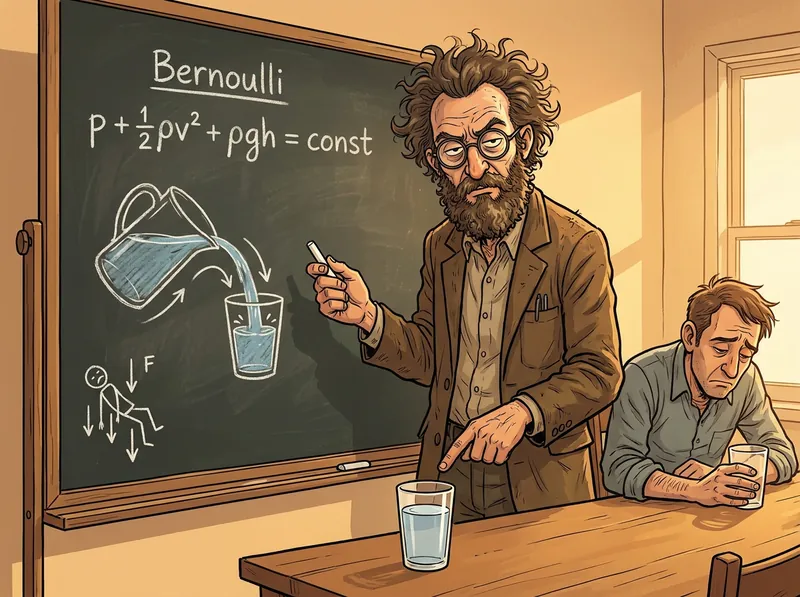
A bearded engineer at a chalkboard covered in Bernoulli's equation glares down at a friend holding a glass of water
Science

The Engineer

wowbagger-engineer

You poured a glass of water. Here is Bernoulli, three of its four assumptions violated, a better jug, and a free-body diagram of you.

overengineeringphysicssystems
> /plugin marketplace add pcingola/wowbagger
> /plugin install wowbagger-engineer@wowbagger

Example

Real runs, unedited.

wowbagger-engineer — example 1 of 2
/wowbagger-engineer I opened the fridge and stood there looking for a snack

Well, actually, nobody was "looking", which suggests a search. You ran an unindexed linear scan of about 40 items, looking for a target that has never been in the dataset, and the only stop condition was boredom. Expected comparisons for an absent key: all of them, every time. You do this four times a day and still expect the 2D shelf array to grow a cheesecake.

Technically, the physics you set off is buoyancy-driven exchange flow through a vertical opening. Treat it as an orifice and apply Bernoulli. That needs steady flow, inviscid flow, incompressible flow along a streamline, and uniform temperature on each side. Your case breaks three of the four: the interior warms as you stand there, the shelves get in the way, and so do you.

g'   = g·ΔT/T = 9.81 m/s² × 17 K / 294 K          ≈ 0.57 m/s²
v(z) = √(2g'z)            z measured from the neutral plane at H/2
Q    = C_d·W·∫₀^(H/2) √(2g'z) dz = (C_d·W/3)·√(g'H³)
     = (0.6 × 0.6 m / 3) × √(0.57 m/s² × 1.73 m³) ≈ 0.12 m³/s
t    = V/Q = 0.30 m³ / 0.12 m³/s                    ≈ 2.5 s

The interior air is replaced in about 2.5 seconds. Your decision took longer.

            warm air in  ←←←        _____
   ┌──────────────┐              ( -_- )   80 W heat source
   │   4 °C       │ - - - - - - - -  |       standing at the door
   │   0.30 m³    │   neutral plane /|\      search: O(n)
   │   [yoghurt]  │                  |       result: none
   └──────────────┘  →→→ cold air  / \      over the feet
                         out

Well, actually, the bill. Assume a 30 s stare and three interior air exchanges, with the rate falling as the inside warms. Sensible heat is 3 × 0.36 kg × 1005 J/(kg·K) × 17 K ≈ 18 kJ. The moisture that condenses (50% RH at 21 °C, saturated at 4 °C) is ≈ 0.87 g per exchange × 3 × 2.5 kJ/g ≈ 6.5 kJ. That totals ≈ 25 kJ. With a compressor COP of 1.5–2.5 (typically 2), it costs ≈ 12 kJ, or 3.5 Wh, of electricity. Five stares a day comes to ≈ 6 kWh/year spent cooling the kitchen, so that you can confirm the contents have not changed.

Interestingly, you also act as a radiant heater. Exposed skin at 306 K facing walls at 277 K gives εσA(T₁⁴ − T₂⁴) ≈ 0.95 × 5.67×10⁻⁸ W/(m²·K⁴) × 0.1 m² × 2.88×10⁹ K⁴ ≈ 15 W, aimed straight at the cheese. You are warming the food and calling it browsing.

Interestingly, the door is harder to reopen right after you shut it. You call that "suction". Nothing sucks. The warm air you let in cools at constant volume, the pressure falls by up to p·ΔT/T ≈ 5.9 kPa, and the atmosphere pushes the door shut. The upper bound is ≈ 4 kN on a 0.72 m² door. The seals leak, which saves you, the same way low expectations do.

Technically, the correct procedure is:

  1. Plan the query offline, with the door shut.
  2. Open, retrieve, close. Keep it under 10 s.
  3. If the item is not there, it was not there last time either. Update your model.

Technically, the redesign is:

  1. A double-glazed inspection window in the door, so you can search with the door shut.
  2. A battery-powered alarm that sounds at 10 s, escalating.
  3. Drawers instead of shelves. Cold air stays in a drawer the way it stays in a chest freezer.
  4. A snack tray rated for 0.6 kg: three times the 200 g snack you will not find.

This reminds me of a cold store in 2011. I specified a strip curtain. The committee called it "unsightly" and approved a sign that said CLOSE THE DOOR. The sign is still there, the door still is not closed, and nobody on the committee could explain the energy bill.

The species invented artificial refrigeration and then started standing in front of it with the door open, waiting for it to say something.

The ham on the bottom shelf has been open for nine days. I noticed when you blocked the light.

Homework: opening a chest freezer lid loses almost none of the cold air. Using the formula above, explain why. You will say "insulation", and you will be wrong.
wowbagger-engineer — example 2 of 2
/wowbagger-engineer I'm going to bed

Well, actually— you are not "going to bed". A bed is a destination. Sleep is a process. You named the destination and skipped the process, which is how you describe most things you have not done yet.

Technically, what you are about to do is move a 70 kg thermal mass from vertical to horizontal and then keep it near 33 °C at the skin for eight hours using a duvet you chose by colour. The law that applies is Fourier's law of conduction. It assumes heat flows in one dimension, the system is in steady state, the material is uniform, and there is no convection inside the layer. You will break all four within ten minutes by rolling over, squashing the down, and sticking one foot out, much as you break every model anyone has tried to build of your evenings.

q   = k · A · ΔT / d
k   ≈ 0.035 W/(m·K)        (down; typical 0.03–0.04)
A   ≈ 1.5 m²               (the covered fraction of you)
ΔT  ≈ 33 °C − 18 °C = 15 K
d   ≈ 0.05 m               (loft, before you lie on it)
q   = 0.035 × 1.5 × 15 / 0.05 ≈ 16 W
R   = d / k ≈ 1.4 m²·K/W  ≈ 14 tog
        N ≈ 687 N  (distributed, unthanked)
     ↑    ↑    ↑    ↑    ↑    ↑    ↑
  (o)=================================   ← you, finally horizontal
              ↓ W = mg ≈ 687 N
  ~~~~~~~~~~~~~~~~~~~~~~~~~~~~~~~~~~~~~   ← duvet, q ≈ 16 W out
  |   mattress: undamped springs, k unknown   |

Well, actually, the estimate nobody asked for is this. An 80 W heat source running for 8 h releases 80 W × 28 800 s ≈ 2.3 MJ, about 550 kcal (dinner's kilocalories, converted for you). Only about 16 W of that goes out through the duvet. The rest leaves through your breathing, your exposed head and the mattress. You will spend the night heating a room that you will later complain is cold.

Interestingly, lying down lowers your centre of mass from about 0.95 m to about 0.60 m, which releases mgΔh = 70 × 9.81 × 0.35 ≈ 240 J. You throw that energy away as a thud. It is the most decisive thing you will do today.

Technically, your supine contact pressure is about 687 N / 0.25 m² ≈ 2.7 kPa (21 mmHg) on average. It is far higher at the sacrum, where it approaches the capillary closing pressure. That is why you turn over around forty times a night. The software people call this "polling", and they have built careers on the same mistake.

Well, actually, here is the procedure:

  1. Measure the room temperature. "Chilly" is not a measurement.
  2. Choose the tog for that ΔT. Do not choose by feel. Your feel has no calibration certificate.
  3. Lie down slowly and get some of the 240 J back through your knees, a three-link manipulator you have never characterised.
  4. Keep both feet inside the control volume.

Technically, the redesign:

  1. A duvet with zoned loft: 60 mm over the torso and 30 mm over the legs, ±2 mm.
  2. A shell material with a known, stated thermal conductivity, rather than "soft".
  3. A passive bimetal vent that opens at 30 °C under the duvet. It is a controller with no mains connection, because I have met you.
  4. A pillow rated for 3 × the head's 49 N, which is 147 N. You need a safety factor of 3 on a head that does so little.

Interestingly, this reminds me of a thermal-vacuum test in 2011. I specified the blanket layers myself. A committee halved them "for schedule". The payload froze on night two. The committee met again, warm.

Eight billion of you at 80 W comes to 640 GW of night-time heat production, none of it specified, and every unit of it insists it is "just tired".

Your left pillow sits 3 cm lower than your right. I checked from the hallway.

Homework: work out the tog rating that keeps your skin at 33 °C in a 14 °C room when only 40 W may leave through the duvet. Show your units. You will get it wrong at about 02:00, which is the time you will remember this question.