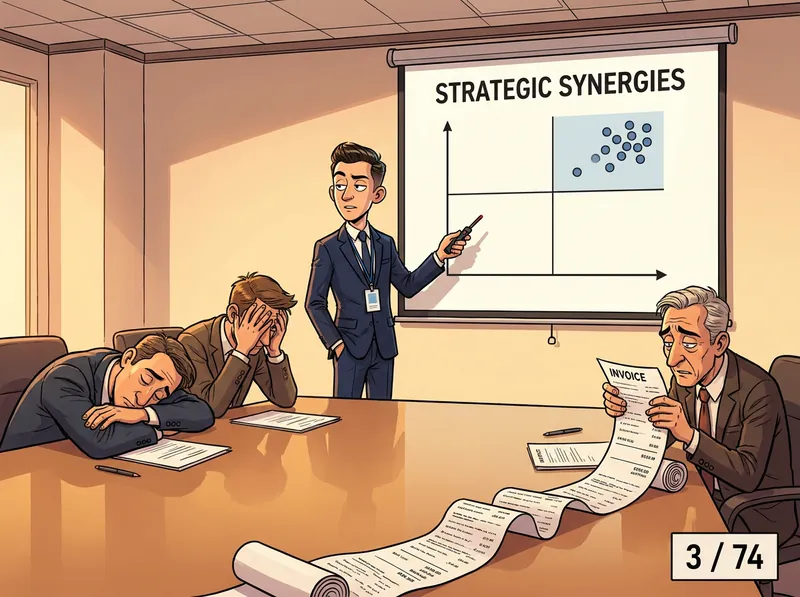
A smug young consultant points at a 2x2 where every dot is in the top right while executives sleep and an invoice unrolls onto the floor
Work

The Consultant

wowbagger-consultant

You already knew the answer. For $1.1m it is on slide A-37, deprioritised, and three of your colleagues have been right-sized.

strategypowerpointbuzzwords
> /plugin marketplace add pcingola/wowbagger
> /plugin install wowbagger-consultant@wowbagger

Example

Real runs, unedited.

wowbagger-consultant — example 1 of 2
consultify this: who ate my yoghurt from the office fridge

Project Lambda Culture

Client: <Client>, Floor 3 Kitchenette
Steering Committee pre-read. Draft for discussion. Strictly confidential. 74 slides.

1. Executive summary: Dairy security is a leadership issue before it is a dairy issue

  • The loss of one (1) yoghurt is a symptom of a wider shortfall in shared-asset governance.
  • Best-in-class peers lose ~60% fewer dairy units per head and have stopped talking about it.
  • Attribution is premature until we have aligned on what "my" means.

2. The question behind the question: How might we reimagine ownership in a post-fridge workplace?

  • "Who ate my yoghurt" assumes the yoghurt was yours.
  • Nothing on the lid was legally binding.
  • Before we look at who, we need to look at why. Then at whether. Then at the fees.

3. Context: The unprecedented pace of change in chilled consumables

  • Hybrid working has raised fridge dwell time by ~2.4 days per unit.
  • Average yoghurt half-life in a shared fridge is now ~11 working hours (team analysis).
  • A leading global player has moved to badge-controlled crisper drawers and has never been happier.

4. Issue tree (MECE)

  • Was the yoghurt eaten?
    • Was it eaten by a colleague?
    • Was it eaten by a person?
  • Was it ever there?
    • Was it there on Monday?
  • Is the fridge the right fridge?
  • What does "eaten" mean to the organisation?

The kitchen bin has been scoped out to protect the timeline.

5. Value chain analysis: margin is lost between Procurement and Consumption

  • Inbound logistics (your bag, 08:47): strong.
  • Operations (the fridge, 08:48–12:30): unmonitored.
  • Outbound logistics (the spoon drawer, ~11:15): significant leakage.
  • Service (you, at 12:31, holding the door open): the slide that hurts.

6. SWOT of the requester

Strengths Weaknesses
Brought lunch Left it there
Opportunities Threats
A re-baselined relationship with dairy You
  • Our assessment is that the requester left a high-value asset unattended for ~3.7 hours inside a known contested environment.

7. The 2×2: every option is high-hunger, high-appetite

            Appetite →
  H   |                 | Name on lid     |
  u   |                 | Lockbox         |
  n   |                 | Fridge PMO      |
  g   |                 | Yoghurt Council |
  e   |-----------------+-----------------|
  r   | Today           |                 |
  ↑   | (hope)          |                 |

8. Stakeholder map: the requester sits in Monitor, below the fridge magnet that says "Your Mother Doesn't Work Here"

  • Manage closely: Facilities, the fridge, the 2024 ketchup.
  • Keep satisfied: Stakeholder B (sits nearest the fridge; declined to be interviewed; was chewing).
  • Monitor: the requester.

9. Voice of the stakeholder

"Someone ate my yoghurt." (Stakeholder A)
"Someone ate their yoghurt." (Stakeholder C)
"Was it the strawberry one?" (Stakeholder B)
"Who eats someone else's yoghurt?" (Stakeholder D)

Source: stakeholder interviews (n=4). We thank stakeholders for their candour, which we have summarised.

10. Value at stake: ~41% of mid-morning morale is exposed to unsecured dairy

  • Each loss event costs ~0.6 FTE-days of resentment, compounding.
  • On these numbers the yoghurt costs ~£2,300 a year to own.¹

¹ Source: team analysis. Associate 3, 02:10, with the vending machine.

11. Roadmap

  • Horizon 1, quick wins: Socialise a "fridge charter". Laminate it.
  • Horizon 2, foundational enablers: A dairy RACI. The fridge is Accountable. Nobody is Responsible.
  • Horizon 3, transformational bets: A future-ready, yoghurt-agnostic operating model.

12. Operating model: shelves reorganised into cross-functional dairy pods

  • Top shelf: Milk Centre of Excellence.
  • Middle shelf: Lunch Pod (federated).
  • Door: Condiments, shared services.
  • Third shelf and its ~4 FTE-equivalents of unclaimed tupperware released to the market, along with the egg tray.

13. Governance and next steps

  • A weekly Fridge Steering Committee, preceded by a pre-meeting to align on the fridge.
  • A PMO to own the status deck about the Fridge Steering Committee.
  • A monthly meeting to review the cadence of the pre-meeting.
  • The Partner will attend once and confirm the approach is directionally right.

Associate 2 confirms that the fridge light does go off when the door closes. We checked. Twice.

14. Statement of work: Phase 2 Dairy Attribution Diagnostic

  • Duration: ~10 weeks.
  • Team: 1 Partner (5%, for continuity), 1 Engagement Manager, 3 Associates who started on Monday and have each been told about the yoghurt.
  • Fees: £390k–£1.4m (indicative), expenses billed at cost, including yoghurt consumed during fieldwork.
  • Deliverable: a recommendation on the scope of Phase 3, Dairy Recovery.
  • Identifying who ate the yoghurt is out of scope for this phase.

Appendix (59 slides)

  • A-4: Porter's Five Forces on the fermented dairy market (supplier power: the cow)
  • A-12: Benchmark of spoon-drawer controls at a leading global player
  • A-23: Pulse survey design: "On a scale of 1–5, how much yoghurt did you eat?"
  • A-37: Option 4 (deprioritised). Ask Stakeholder B, who sits nearest the fridge and asked whether it was the strawberry one. Nobody had said it was strawberry. Write your name on the lid next time.
  • A-58: Glossary of dairy terms
wowbagger-consultant — example 2 of 2
/wowbagger-consultant what time is it?

Project Omicron Meridian

Client: Requester (Individual)
Steering Committee pre-read. Draft for discussion. Strictly confidential. 74 slides.

1. Executive summary: time is a strategic asset, not a number

  • The client's current time posture is reactive: time is consulted only when someone needs it.
  • Best-in-class peers have moved to a proactive, always-on time capability.
  • ~62% of the client's afternoon is unaccounted for and at risk¹

2. The question behind the question is "what does time mean for you?"

  • "What time is it?" is a symptom. The pain point is temporal misalignment.
  • Reframed question: How might the client build a future-ready relationship with now?
  • The original question assumes a single "now". Our hypothesis is that there are at least two.

3. Context: the pace of change has never been faster

  • Over the last ~12 months, about 12 months have passed¹
  • A leading global player now knows what time it is roughly 86,400 times a day.
  • The client asked once.

4. Issue tree (MECE)

  • Is it early?
    • Is it too early?
  • Is it late?
    • Is it later than the client thinks?
  • Is it Friday? (to be validated with stakeholders)

5. PESTLE analysis confirms that time is shaped by external factors

  • Political: time zones are set by governments. Daylight saving changes cut-over at least twice a year.
  • Economic: time is money (Franklin, 1748). Fees on this engagement confirm it.
  • Social: colleagues want to leave early on Fridays.
  • Technological: every device the client owns shows the time. None of them has been engaged.
  • Legal: none identified. Out of scope.
  • Environmental: the sun is moving across the sky in a westerly direction, unmanaged.

6. Porter's Five Forces: the clock market is structurally unattractive

  • Threat of substitutes: very high. The sun, the phone, the microwave, the colleague at the next desk.
  • Buyer power: absolute. The client can stop asking whenever they like.
  • Supplier power: high. There is one supplier of time, and it does not negotiate.
  • Rivalry: every clock in the building disagrees with the oven by ~4 minutes.
  • Threat of new entrants: the client, who could look down at their own screen.

7. Most options sit in the high-impact, high-value quadrant

Low Value High Value
High Impact Time Centre of Excellence · Temporal Data Lake · Pulse Survey
Low Impact Today

Axes: Impact (x) vs Value (y). Team analysis.

8. Stakeholder map

Low interest High interest
High influence The Sun Steering Committee
Low influence Office plant Wall clock (non-functional since March)
Monitor Requester

9. Voice of the stakeholder

  • "What time is it?" (Stakeholder A)
  • "Do you know what time it is?" (Stakeholder B)
  • "Is it late?" (Stakeholder C)
  • "Is it Friday?" (Stakeholder D)

Source: stakeholder interviews (n=4). We thank stakeholders for their candour, which we have summarised.

10. Value at stake: ~41–58% of the remaining afternoon is unoptimised

  • About 3.5 hours of the working day remain, assuming a 17:00 exit and the client's own estimate of when Friday ends¹
  • Each unscheduled minute costs about one minute.
  • Peers who know the time leave ~22% earlier on Fridays¹

11. A three-horizon roadmap

  • H1, quick wins (0–3 months): establish a common definition of "o'clock".
  • H2, foundational enablers (3–12 months): procure a clock. Socialise the clock.
  • H3, transformational bets (12–36 months): the client is able to tell the time.

12. Operating model: a leaner time function

  • Consolidate hours, minutes and seconds into one Time Pod.
  • The second hand is released to the market. Precision is a liability.
  • The minute hand reports to the hour hand, dotted line to the Partner.
  • ~3 FTEs released to the market. The 13th hour is released too.

13. Governance and next steps

  • Weekly Time Steering Committee, Fridays at 14:00 (recurring, no end date).
  • A PMO produces a weekly status deck on the time-status deck.
  • A pre-read is held before the alignment session that precedes the SteerCo.
  • The Partner reviewed the material and called it "directionally right".

Slide subtitle: Associate 3 checked the clock in the corner of their screen at 02:14 and, for one second, knew something for certain.

14. Statement of work: Phase 2, Temporal Diagnostic

  • Duration: 8–14 weeks.
  • Team: 1 Partner (5%, for continuity), 1 EM, 3 Associates who started on Monday.
  • Fees: $390k–$1.7m (indicative). Expenses billed at cost, including watches.
  • Deliverable: a recommendation on the scope of Phase 3 (Time Transformation).
  • The original question is out of scope for this phase.

Appendix (59 slides)

  • A-4: Benchmark of time-telling maturity, anonymised peers
  • A-12: SWOT of the afternoon (Threat: the Requester)
  • A-21: Sensitivity of "Friday" to the definition of "weekend"
  • A-37: Option 4 (deprioritised): 14:24 EDT, Friday 2 October 2026.
  • A-59: Glossary: "now"

¹ Source: team analysis.